The Wrong Diagnosis
Everyone has a theory about what's wrong with designers right now.
They care too much about craft. They don't understand the business model. They resist AI. They optimize for peer approval instead of user outcomes. They hide behind process. They can't hold a number like a PM or a deadline like an engineer.
Some of this is true. I've worked with designers like this. Early in my career, I was one.
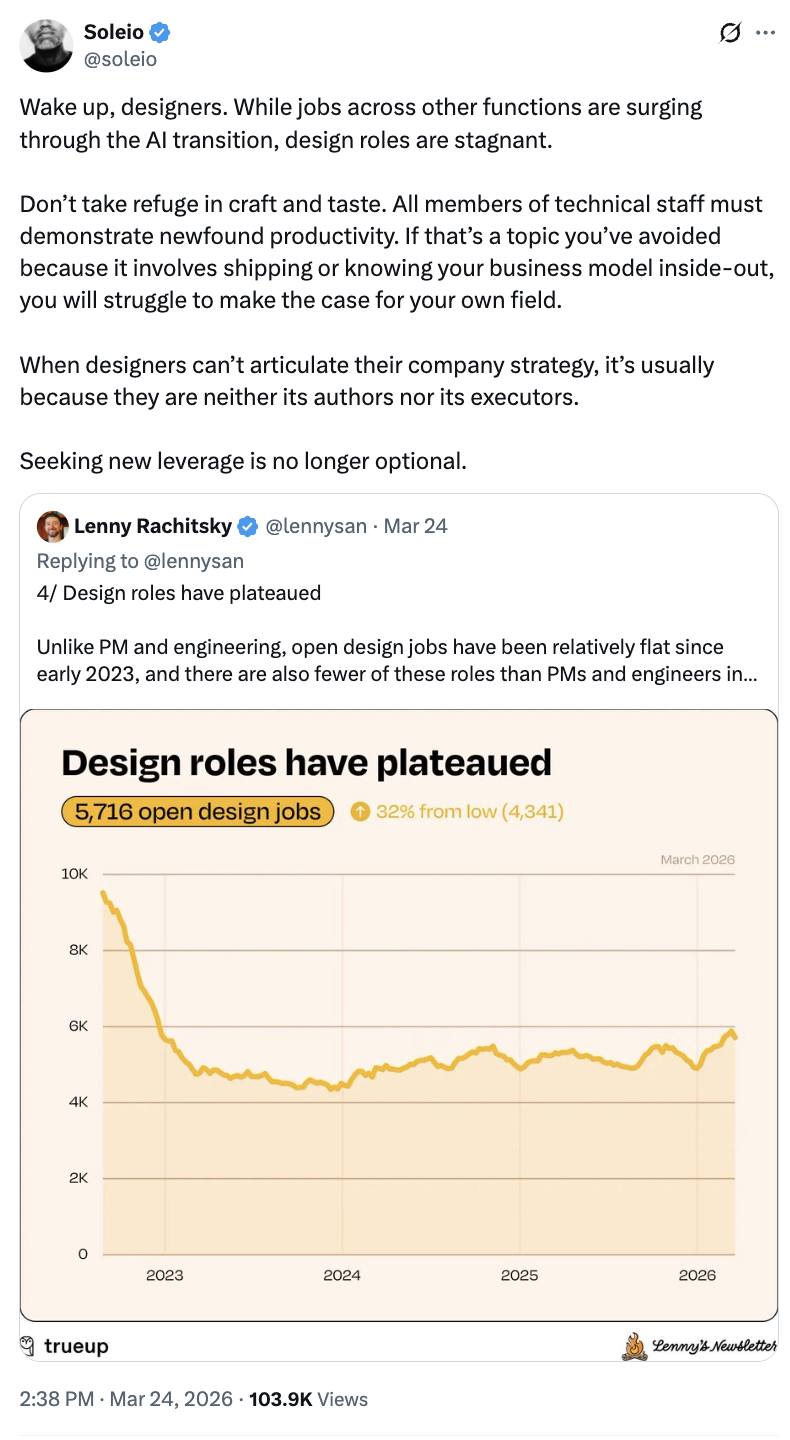
But the reaction to Lenny Rachitsky, the former Airbnb PM turned product-management writer, and his March 2026 job-market data1 has collapsed several different problems into one moral verdict.
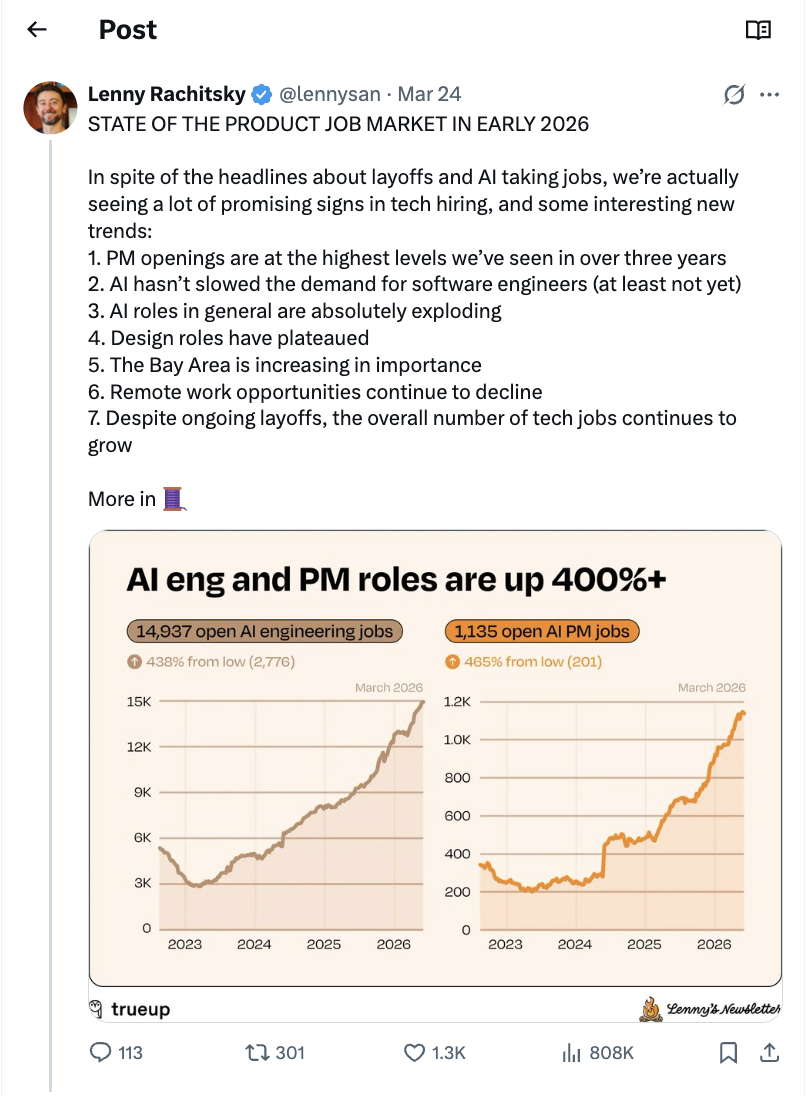
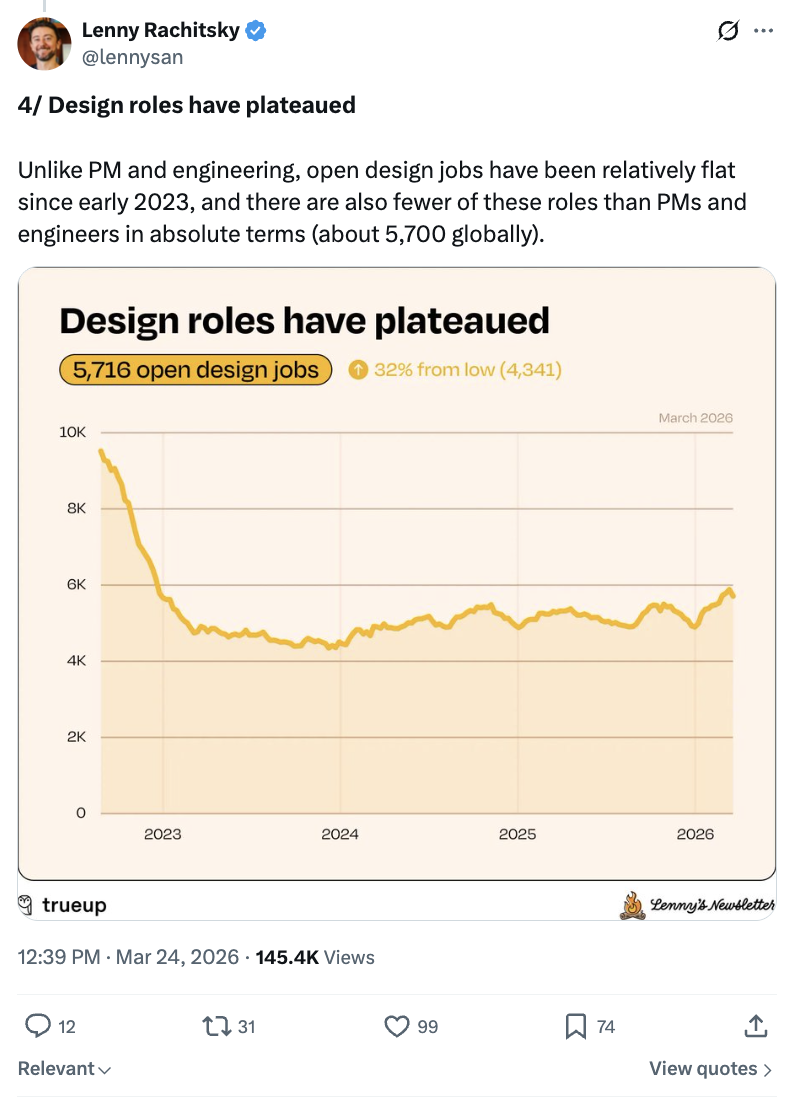 Design roles have been relatively flat since early 2023 — around 5,700 global openings — while PM roles surged above 7,300 and engineering past 67,000. The PM-to-designer demand ratio flipped in mid-2023 and now stands at 1.27x. That gap is real. But it is too convenient to read it as proof that designers suddenly became less talented, less necessary, or less serious than their peers.
A better explanation is harsher and more structural: design is in a jurisdiction fight, and it is losing.
The Old Model Broke Because Building Got Cheap
For years, the EPD triad made intuitive sense. Marty Cagan, founder of Silicon Valley Product Group, codified it as the empowered product team — a product manager, a product designer, and an engineering lead, working as equal partners to solve problems rather than execute feature requests.2 Product discovery coach Teresa Torres formalized it as the "product trio."3 The model assumed a specific production reality: software was expensive to build, expensive to change, and slow to ship. If engineering cycles were long, then heavy investment in deciding what to build — research, exploration, reviews, specs, handoff — was not arbitrary process theater. It was risk reduction.
AI has changed that cost structure. In controlled research, developers using GitHub Copilot completed tasks roughly 55% faster than a control group.4 Pull request cycle times dropped from 9.6 days to 2.4 — a 4x acceleration.5 Y Combinator leadership has said that for a quarter of its Winter 2025 batch, roughly 95% of code was AI-generated.6 These are not universal measures of software productivity, and they should not be stretched further than they go. But they point in the same direction: the cost of turning an idea into something testable has fallen dramatically.
And once building gets cheaper, the old coordination model starts to feel expensive.
That does not mean design became less valuable. It means many organizations stopped waiting for it. When an engineer can go from idea to functional prototype in a day7, the handoff model — PM writes requirements, designer mocks it up, engineer builds it — becomes a bottleneck. Not because the mockup wouldn't have been better, but because the org doesn't want to pay the coordination cost anymore.
This is not the same as design being unnecessary. It's design losing its structural position in the production loop.
The Power Deficit Predates AI
There is evidence that this is not a new problem dressed up in AI clothing. Design has had a power deficit for a long time.
McKinsey's 2019 survey of design leaders and senior executives found that only 1 in 10 CEOs said their senior designer played a meaningful role in strategy development. Only about a third of CEOs and direct reports could confidently say what the head of design was even accountable for.8 Spencer Stuart's Fortune 500 C-suite snapshot tracks eleven common executive roles — CEO, COO, CFO, CHRO, CIO, CMO, and others. Chief Design Officer does not appear on the list.9 Not because design doesn't create value, but because design doesn't have the institutional infrastructure that other functions built over decades.
The numerical imbalance compounds the governance gap. The typical designer-to-developer ratio across the industry runs 1:10 to 1:20. MeasuringU's survey data shows the most common ratio is 1 designer per 20 developers and 1 researcher per 100 developers.10 NNGroup's research shows UX budgets have remained at approximately 10–11% of project spending since 2007 — barely moving despite explosive growth in UX headcount globally.11
And yet: the same McKinsey team that found CEOs ignoring their designers also found, in a separate study of 300 publicly listed companies, that top-quartile design performers achieved 32 percentage points higher revenue growth and 56 points higher shareholder returns than their industry peers.12 The Design Value Index showed design-centric companies outperforming the S&P 500 by 211% over a decade.13 Forrester's study of IBM's Design Thinking practice measured an ROI of 301%, with teams reaching market 2x faster and software defects reduced by over 50%.14
This is the paradox at the center of everything: the function that demonstrably creates the most value per seat has the least power to protect its seat.
What Happens When Design Has Real Power
If you want to see what happens when design has real structural power, look at Airbnb. Brian Chesky — trained at RISD, the only designer-CEO in the Fortune 50015 — made design the organizing principle of the company. Not a support function, not a service org, but the lens through which every product decision flows. The result: $78 billion valuation, $4 billion in free cash flow, and a product with a level of coherence that competitors with 10x the engineering headcount can't match.
But Chesky's own framing reveals the problem. At Figma's Config 2023, he said that design is "fragile" in most organizations, that the creative process "requires nerve," and that maintaining a design-led culture demands founder-level conviction.16 In other words: design at Airbnb works because a designer occupies the single most powerful structural position a company has. Without that, the function loses leverage by default.
There is a nuance here worth noting. Companies where founders and executives genuinely see design as a growth lever may also select for, reward, and retain designers who are more commercially minded in the first place — designers who connect user experience to adoption, retention, trust, and revenue. Leadership structure matters. But so does the kind of designer the structure privileges. The best environments produce the best designers, and vice versa. The problem is that most companies never built the environment.
That should alarm designers far more than any job market chart.
Why PM Survived and Design Didn't
And once you see the problem this way, the more interesting question is not "why is design struggling?" It's "why didn't product management struggle in the same way?"
Because PM should have been vulnerable too. If AI lowers the cost of building and prototyping, why do you need a separate function to decide what to build? Why not let engineers run discovery directly?
The simplest answer is not that PMs are more talented than designers. It's that PM has stronger institutional infrastructure. Product has a clearer ladder into authority, a more legible executive endpoint, a more standardized language for tradeoffs, and — most important — a stronger claim over business outcomes. PMs are not merely the people who write tickets. In healthy organizations, they are the people who can be held accountable for prioritization under uncertainty. That is a jurisdictional claim executives understand.
Design has rarely made an equally durable claim. Designers influence conversion, activation, retention, trust, usability, satisfaction, and brand preference. But influence is not the same thing as owned accountability. "I advocate for the user" is morally admirable. It is not, by itself, a stable basis for organizational power.
Ronald Burt, sociologist at the University of Chicago, and his structural holes theory from organizational sociology explains the mechanism: people whose networks bridge disconnected groups enjoy disproportionate compensation, evaluations, and influence.17 PMs increasingly occupy that bridging role — sitting between engineering, stakeholders, and customers — accumulating structural influence regardless of the intrinsic value of design work. When design reports under product rather than independently, designers lose their brokerage position entirely.
That may be the hardest truth in all of this.
The Critics Aren't Entirely Wrong
Pretending this is purely structural is its own kind of cope. The critics get some of it right.
Claire Vo, CPO at LaunchDarkly and creator of ChatPRD, made a point about design culture being broken at many companies that is real.18
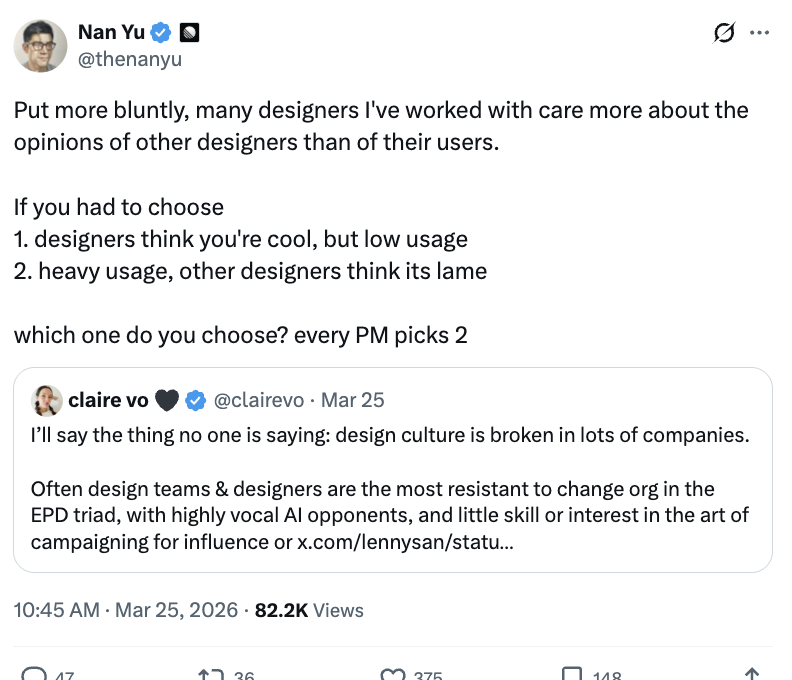
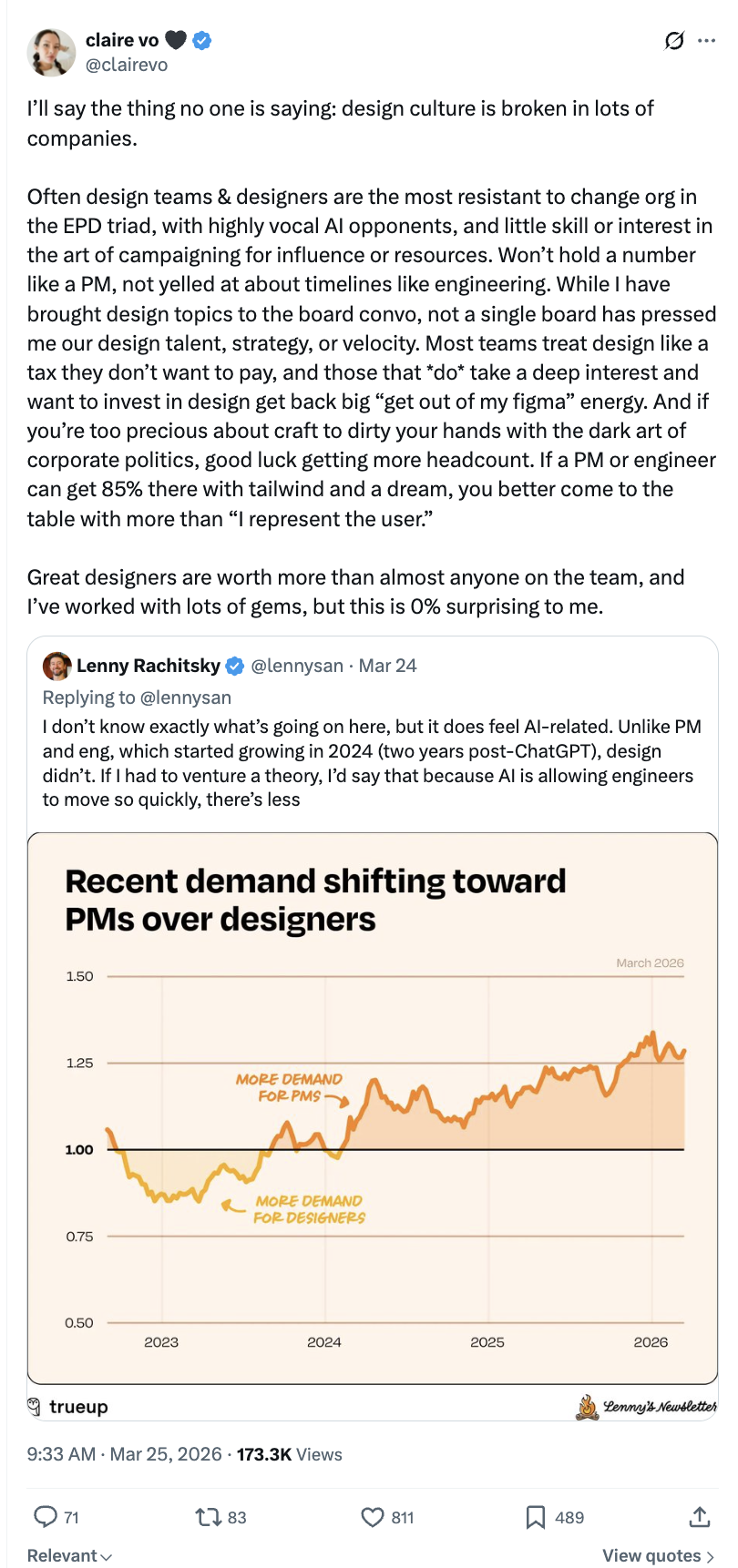 She described designers as "the most resistant to change org in the EPD triad, with highly vocal AI opponents, and little skill or interest in the art of campaigning for influence or resources." That's a sharp diagnosis, and it's not wrong about the pattern it describes. Nan Yu, Head of Product at Linear, observed that many designers he's worked with care more about the opinions of other designers than their users is also recognizable.19
 Suff Syed, Head of Product & Design at Microsoft Research, argued that PMs with technical fluency are bypassing the design function entirely — going straight from idea to codebase — is already happening.20
And the Dribbble effect is real. Design crit culture optimized for peer approval over user impact. The portfolio-driven career incentive — make it look impressive to other designers so you can get the next job — created a genuine misalignment between what designers optimized for and what companies needed.
But the critique has a blind spot: it treats the symptoms of powerlessness as the cause.
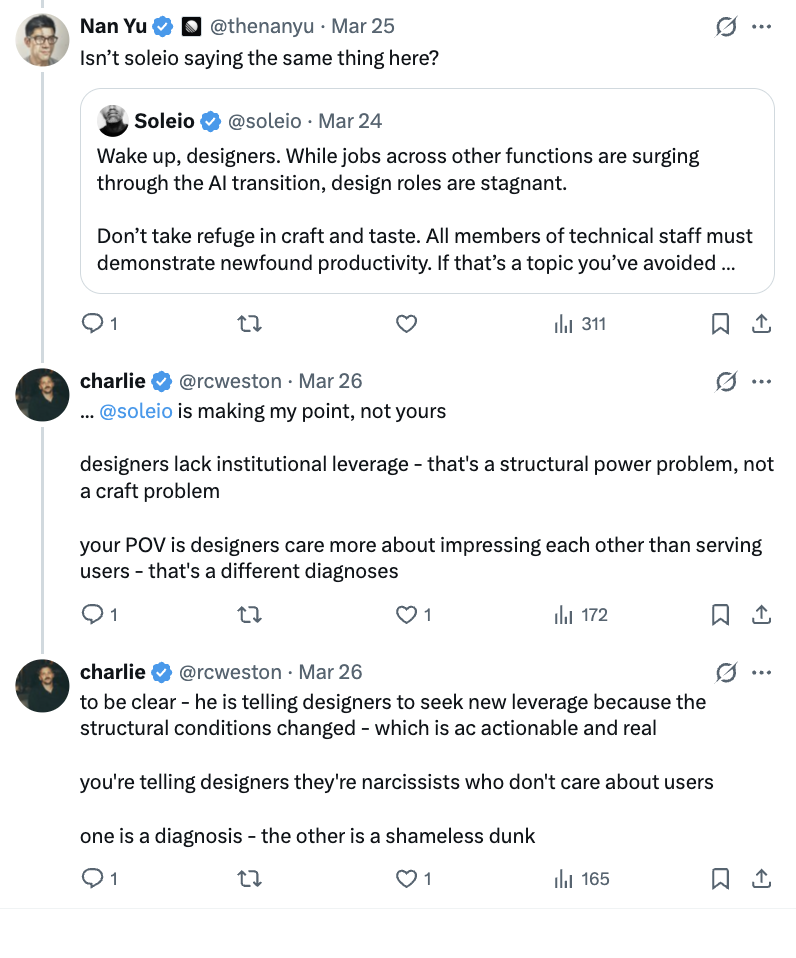
When your team doesn't own the roadmap, doesn't own the number, rarely reports independently, and often lacks durable executive representation, you protect the territory you do have. You retreat into craft because craft is one of the few things you fully control. You optimize for peer recognition because peer recognition is one of the few currencies you can accumulate without organizational power. You defend your process because process is often the only mechanism that guarantees your involvement at all.
These aren't signs of a discipline that doesn't care about users. They're signs of a discipline that got squeezed out of strategic decisions and adapted to the territory it had left.
The Risk Is Absorption, Not Extinction
The disciplines that lost this fight before design all followed the same trajectory. QA never became unimportant. Testing did not vanish. But the dedicated jurisdiction of the QA organization weakened as engineering teams absorbed more of that responsibility. Microsoft's retirement of the SDET role in 2014 is the clearest example: 18,000 people laid off, the work redistributed to developers.21 The "shift left" movement wasn't an argument that quality didn't matter. It was a jurisdictional transfer — valuable work, absorbed by a more powerful function.
Technical writing followed the same pattern. Canva laid off 10 of 12 technical writers in 2025 shortly after pushing AI adoption company-wide. Google's "Every engineer is also a writer" program trained engineers to own their own documentation.22 The work survived. The department didn't.
Andrew Abbott, sociologist at the University of Chicago, and his The System of Professions provides the framework: professions exist in an interdependent system where they compete over "jurisdictions" — claims of ownership over expert knowledge.23 When technology shifts or new groups emerge, those jurisdictional boundaries get contested. The weaker profession does not lose because its work has no value. It loses because it lacks the institutional machinery to keep exclusive claim over that value.
Design — with its diffuse academic foundations, its lack of licensing or credentialing, and its chronic underrepresentation in executive governance — is structurally positioned to lose this contest.
Craft Is Not the Problem
But the obituary writers get something critically wrong about craft.
There is a version of the "stop being precious" argument that is correct, and a version that is corrosive. The correct version says: craft in service of nothing is self-indulgent. A beautiful interaction that doesn't improve comprehension, trust, retention, or usability is decoration. The corrosive version says: craft itself is a luxury, and in an AI-accelerated world, good enough is good enough.
Good enough is how you get products people tolerate instead of products people love. Good enough is how you get a market of indistinguishable AI wrappers that all work and none of them feel like anything. Good enough is a competitive strategy that works until someone with real craft enters the market and makes you look like a placeholder.
The companies that have generated the most durable value in tech — Apple, Airbnb, Stripe, Figma — are companies where craft was treated as a strategic instrument, not an aesthetic indulgence. Apple's market cap exceeded $4 trillion; when Jony Ive, Apple's former Chief Design Officer and now founder of LoveFrom, announced his departure, the stock immediately dropped, erasing roughly $9 billion in value — the market's literal pricing of a single designer's structural contribution.24 Stripe's design quality — applied to API documentation, developer tools, and onboarding — is its primary competitive moat at a $91.5 billion valuation. Figma's IPO saw shares surge as much as 275%.25
Craft is not refuge. Craft is leverage — when it's connected to outcomes.
What Designers Should Actually Do
Not nostalgia for the old process. That process was adapted to a slower production environment, and some of it deserves to die. Not "learn to code" as a slogan, either — technical fluency matters, but the shift is broader than that. And definitely not "we have taste and they don't" as a defense. Taste is real. But you cannot taste your way out of a structural power deficit. You cannot taste your way into a board conversation that was never going to include you.
The more serious answer is that design has to make a stronger jurisdictional claim. Not over artifacts, but over judgment.
That means being the fastest, clearest route to answering questions like: Is this worth building? For whom? Where does the user get confused? What should be simplified? What tradeoff are we making? What evidence would change our mind?
If design's value proposition is artifact production alone, it will keep getting compressed. If its value proposition is better product judgment under conditions of speed, ambiguity, and technical abundance, it has a chance to become more central, not less.
Concretely: own outcomes, not deliverables. If your value prop to the company is "I make the mockups," you are already dead. If your value prop is "I'm the person who can tell you whether this thing you built in a weekend is going to work for the humans who have to use it" — that's judgment, and judgment scales.
Learn the business model cold. Not because you need to become a PM, but because the only way to have strategic influence is to connect design decisions to business outcomes in language the CEO understands. Claire Vo is right that most designers can't do this. She's wrong that this makes them dispensable. It makes them underequipped for a fight they need to be in.
Get closer to the code. Not to become an engineer, but to close the gap between intention and implementation. The handoff is dying.26 The designers who stay in the loop are the ones working directly in codebases with AI tools — not because they stopped being designers, but because the distance between "this is what it should be" and "this is what it is" has to collapse. Designers who can prototype in code, pair with engineers, and iterate in-browser will survive. Designers who hand off Figma files and wait will not.
And fight for structural position explicitly. Push for design to report independently. Push for design representation in strategy conversations. Push for a seat at the table that isn't conditional on a PM's invitation. This is political work, and most designers find it distasteful. But the alternative — retreating into craft while the org chart rearranges around you — is how you end up as the next QA.
The Actual Contest
The labor-market chart is not telling us that design has no future. It is telling us that design's old jurisdiction is no longer secure. Those are not the same thing.
But naming the structural problem is not enough. Structure doesn't change because someone correctly identified it. It changes because someone with enough leverage fought to change it — or because someone built something so undeniably good that the structure had to bend around them.
That's the actual game. Not who ships fastest. Who builds the thing that was worth building.
Notes